

As machines take over the typing, “back to basics” is only half an answer to what children should learn. I saw the other half on a classroom carpet six years ago, during my graduate studies, as I designed and implemented activities to bring computational thinking into math classrooms.
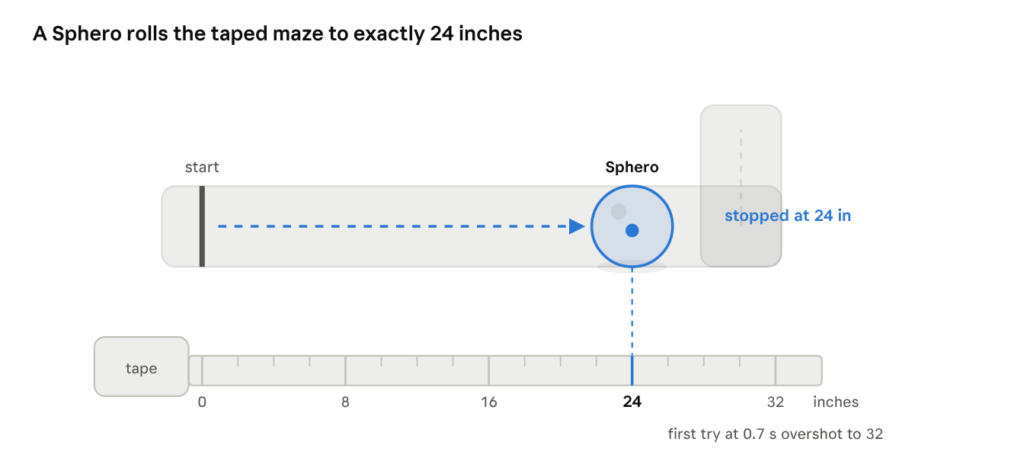
Six years ago, in a fourth-grade mathematics classroom in Washington, DC, two students were trying to make a small spherical robot roll exactly 24 inches.
Their first program told the robot to roll at speed 50 for 0.7 seconds. It travelled 32 inches. Too far. They cut the time and it stopped short. They argued, changed the number, ran it again, measured again. At 0.57 seconds they were close, but close was not what the task asked for. Then one of them proposed something nobody had suggested to them: a third decimal place. They typed 0.573. The robot stopped at 24 inches.
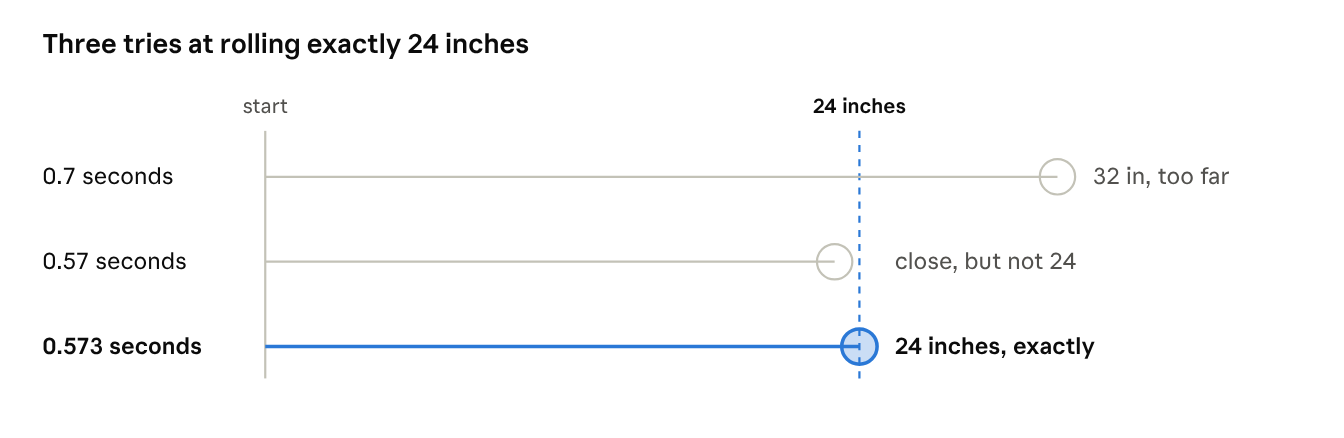
No curriculum-designed worksheet had asked them for the thousandths place; they figured that out themselves. No adult or teacher instructed them that the answer was wrong. They were thinking computationally in mathematics contexts – they had a prediction, a robot that disagreed with their response, a tape measure that measured the distance, and each other to think and collaborate with.
I wrote about that classroom at the time. I have thought about it far more often since, because it answers a question that few people were asking then and almost every parent is asking now.
In hindsight, the years I have spent studying how children learn computational thinking were probably setting the stage all along to answer these questions today. I argued that the ubiquity and heavy presence of computational tools across almost every human activity make it imperative for every learner, regardless of their age, to develop computational thinking skills in order to interact with these tools.
The question on every parent’s mind
Last week CNN put it in a headline: AI will eliminate many jobs. What should your children study now? In the interview, the economist Daniel Susskind argues that trying to pick “future-proof” skills is a losing game, because nobody knows what the future will ask for. His cautionary tale is England’s 2013 decision that every schoolchild would learn to code. His advice is to return to the basics of literacy, numeracy, and critical thinking, and to teach children to work both with AI and without it.
I agree with almost all of that. I also spent years inside exactly the kind of classroom that story treats as a warning, so I want to add what I think it leaves out.
First, “the basics” and “critical thinking” are destinations, not directions. Every parent already wants a child who reads well, reasons with numbers, and thinks critically. The real question is what a child should actually be doing on a Tuesday morning to get there, and critical about what.
Second, the coding story is usually read the wrong way round. The mistake was never bringing computing to children. The mistake was confusing the syntax with the thinking. Typing commands in the right order is a skill a machine can now do faster than any of us. But look again at those two fourth graders I mentioned above in a math classroom. They were not learning to code. Code was the occasion. They were measuring, working with decimals, reasoning about how time relates to distance, defending a claim to a partner, and testing an idea against the world until it held. That is the basics, at full depth.
Who writes the rule
To decide what children should learn, we need to be precise about what AI changed. It comes down to one question: who writes the rule?
When a child programs a robot, the child writes every rule. If the robot goes the wrong way, the mistake is in the program and the child can find it. When an AI system is built, people choose a goal and a large set of examples, and the machine works out the rule for itself. If it gets something wrong, the cause is usually in the examples: what was included, what was left out, and how things were labelled.
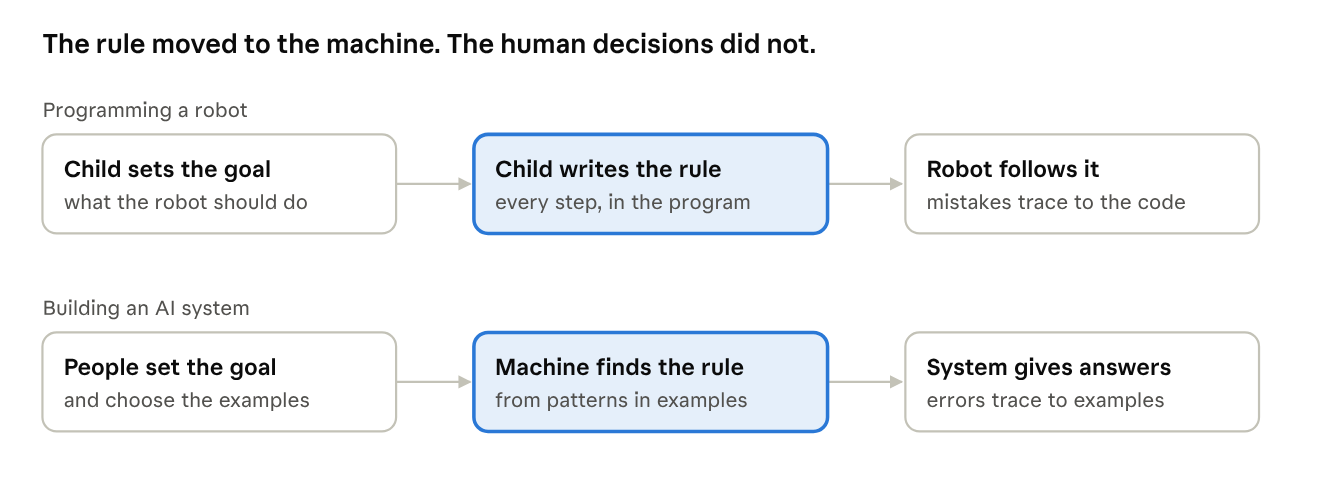
So the rule has moved from the person to the machine. That is a real break, and it is why “learn to code” was never going to be a complete answer.
But something has not moved at all. Someone still decides what the machine sees. Someone decides what it is for, and what counts as a good enough answer. When my colleagues at the National Institute of Standards and Technology and I interviewed members of the public and AI experts about how they understand AI, many of them described it as a “reflection of its creators.” I think they were right. The part of any AI system that a person can always examine is the set of human decisions behind it.
Children should be learning to make those decisions, and to question them.
What is worth learning
So here is my answer to CNN’s question. It is not a list of subjects. It is four practices – critical and computational thinking, really – and each one can live inside the subjects children already take.
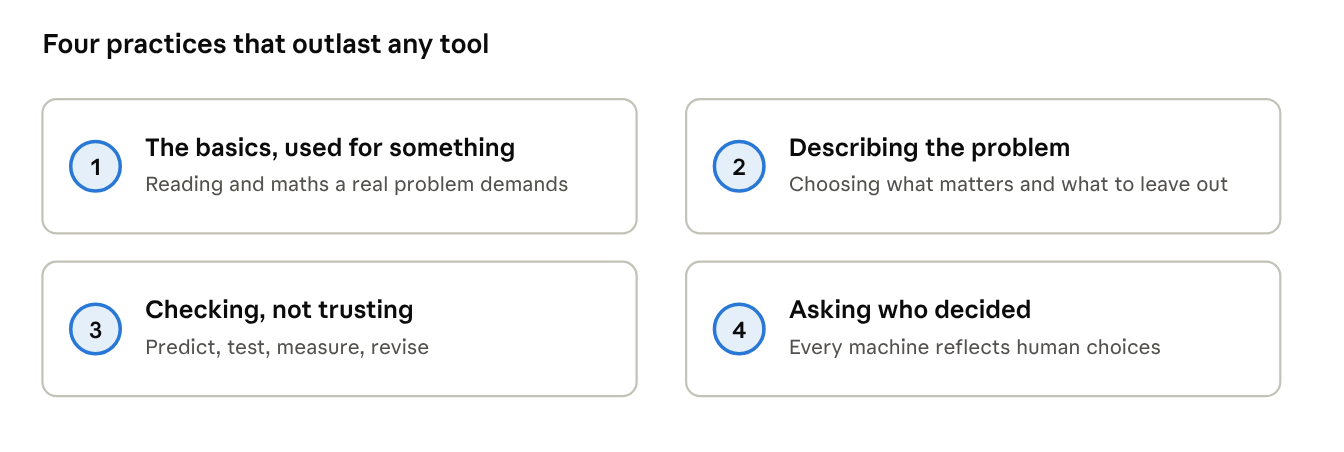
1. The basics, used for something. Reading, writing, and mathematics matter more now, not less. But they grow when children need them. Those two students learned what a thousandth is because 0.57 was not good enough for the job in front of them. Skills practised only on worksheets are the easiest ones to hand to a machine.
2. Deciding how to describe a problem. Before anyone can solve a problem, with or without AI, someone has to decide how to describe it: which features matter, what to measure, what to leave out. I have watched children who could not yet read code fluently use their bodies, drawings, and symbols to plan and debug their programs. Moving between a gesture, a sketch, a number, and a program is serious intellectual work, and young children can do it years before learning the syntax of formal programming.
3. Checking, instead of trusting. The most valuable thing in that classroom was a robot that could say “no” to a confident prediction. Children learned to predict, test, measure, and revise. AI systems give fluent, confident answers that are sometimes wrong, so the habit of asking “how would I check this?” may be the most protective thing a child can carry.
4. Asking who decided. Of a robot program: what did I tell it to do? Of a trained model: what examples did it learn from, and who chose them? Of a chatbot: who built this, on what, and for whose benefit? The question grows with the child, and no one needs to be an AI expert to ask it.
Notice what is not on the list: a programming language, a particular AI tool, or prompt-writing tricks. Those will change. These four practices are what a learner brings to whatever replaces them.
What a robot cannot teach
Programming a robot does not make a child AI literate. I want to be clear about that, because overselling coding as the 21st-century skill is how we ended up with the cautionary tale in the first place, including England’s push for every child to code.
Three limits matter. A child who has only programmed robots may expect every computer to be certain, consistent, and fully traceable, and may read an AI’s mistake as a simple bug. So the break has to be taught directly: when you cannot read the rule, you can still read the human choices around it. Robotics also does not teach children to reason about likelihood and error, which AI depends on, so data and statistics have to grow alongside it. And my claim is about preparation. I am arguing, from classroom research and learning theory, that this early work readies children to learn about AI later. That claim still needs to be tested directly, and I intend to test it.
The limit that worries me most is not about children at all. None of this helps a child who never gets the chance. In our partnership with my advisor, Dr. David Weintrop, and an urban school district, we built computational thinking into fourth-grade mathematics and prepared classroom mathematics teachers to teach it. It reached every student in the room, and it did not depend on an elective, a specialist, or a family that could pay for a camp. If these practices become something only some families can buy, the age of AI will widen the gaps that schools exist to close.
Start with one question
The four practices come down to one question that travels from the kitchen table to the school board: what did people decide here? At home, sort something together, laundry or leaves or toys, and ask your child to explain the rule they used. Then ask what a computer would get wrong if it learned only from those examples. When your child uses a chatbot, ask afterwards how the two of you could check its answer.
In classrooms, give children problems where the world can answer back, where a prediction can fail and be repaired. Let them choose how to describe a problem before they solve it. And put this work inside mathematics, science, and literacy, with the teachers who already teach them. An approach that depends on a separate course will reach the children who need it least.
These practices are the backbone of IFISA, a kindergarten-to-grade-12 STEM and AI framework I designed with Intelligent Futures. You can explore its lessons in the IFISA Academy app.
Back to 0.573
I do not know what jobs those two students will hold. Nobody does, and I distrust anyone who claims to. What I know is what they did that morning. They refused an answer that was nearly right. They found a better way to describe the problem. They checked their idea against the world and changed their minds when the world disagreed.
A machine can now write the program they wrote. It cannot decide, on their behalf, what is worth getting right. That is what children should be learning in the age of AI, and it is well within reach of a nine-year-old with a robot, a tape measure, and a good question.
Dr. Janet Bih Fofang is a learning scientist who studies how children learn to understand and question computing, data and AI. She is the designer of the IFISA STEM and AI framework. Find more of her work at bihjanetshufor.com.
Further reading
- Alaimo, K. (2026, November 20). AI will eliminate many jobs. What should your children study now? CNN.
- Susskind, D. (2026). What should my children do? A human’s guide to the age of AI.
- Math and Sphero roll. HCIL at UMD, Medium.
- Fofang, J. B., Weintrop, D., Walton, M., Elby, A., & Walkoe, J. (2020). Mutually supportive mathematics and computational thinking in a fourth-grade classroom. In M. Gresalfi & I. S. Horn (Eds.), The Interdisciplinarity of the Learning Sciences, 14th International Conference of the Learning Sciences (ICLS) 2020 (Vol. 3, pp. 1389–1396). International Society of the Learning Sciences.
- Jensen, T., Theofanos, M., Greene, K., Williams, O., Goad, K., & Fofang, J. B. (2024). Reflection of its creators: Qualitative analysis of general public and expert perceptions of artificial intelligence. AIES 2024.
- Long, D., & Magerko, B. (2020). What is AI literacy? Competencies and design considerations. CHI 2020.